
Social Media: The Double-Edged Sword of the Digital Age
January 8, 2026
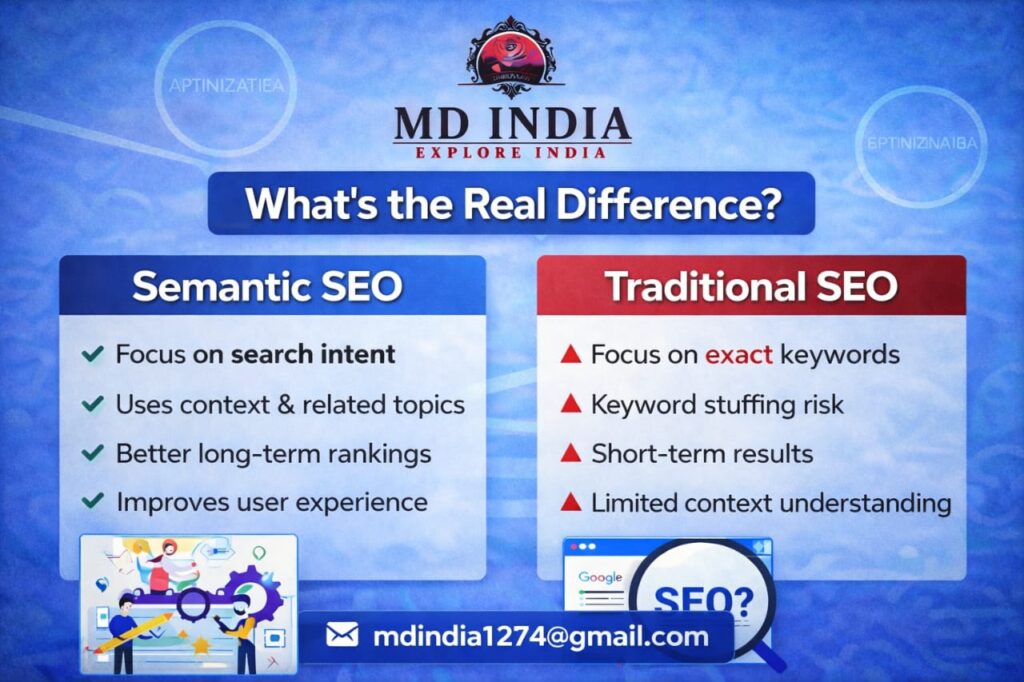
Meta TagsBy understanding how Semantic seo and Traditional SEO differences. it will help you find ways to improve your digital marketing results in today’s level of technology. Semantic SEO has evolved past Traditional SEO by optimizing for search intent, query context and query meaning. focuses strictly on keyword density and backlinks.
As both search algorithms and user behaviour have changed over the years, MD India who is a website development agency based out of India, believes that optimising their products to fit with the evolution of semantic search is essential in order for them to keep their company’s long term visibility and value on search engines.
Take a look at the differences between Semantic and Traditional SEO:
1. Focus on Intent vs Keywords
Traditional SEO typically involves rankings achieved through the keyword method, while semantic SEO expands beyond the keyword approach to include the reader’s intent and meaning in addition to the keyword search. Semantic SEO does not use keyword phrases alone; MD INDIA considers how users connect words and subjects together. For example, based on user intent and how a product relates to those who search for it, an eCommerce website offering products can show up on the first page of results for product-related information being searched for in Jaipur. Such a change will allow for increased activity and accuracy in the results returned from search engines.
2. Content Understanding
In the past, Search Engine Optimisation (SEO) was how you would build an online presence and achieve better rankings in the search engine results pages (SERPS). included providing Meta Tags for the search engine to understand what the web page contained. However, with Semantic Search Engine Optimisation (SEO), you have a different way of understanding how a search engine will read a particular webpage and subsequently, use contextual data as well as the relationships between the various entities within that content to optimise that site for search. Contextual Search Engine Marketing (SEO) is focused on using different forms of contextual data to inform the search engine of the potential to satisfy a user’s needs and to fulfil the intention of a specific search query. MD INDIA provides Semantic SEO Services in India in which its content is created in a manner that is able to naturally meet the user’s needs and intentions whereas traditional keyword-focused SEO would simply have inserted keywords within the content in order to help bring visitors to the site.
3. Search Engine Algorithms
LD School SEO was more about “Ranking Factors” (Backlinks & Keyword Placement), whereas Semantic SEO is more about using sophisticated AI-powered search algorithms that aid in understanding concepts, synonyms, and related terms. MD INDIA builds websites and semantically optimizes them by offering meanings to products/services (via Schema Mark-Up) and also an internal framework for data/information. This ensures that a person searching something vocally receives the relevant information in terms of snippets/knowledge panels.
4. Keyword Strategy
ructured data was not used very often as a component of classic SEO. Semantic SEO is based on schema markup. It includes classification of people, products, and reviews. It further helps in increasing the classification. The implementation of schema by MD INDIA makes it easier for customers to understand Google about their websites. The semantic markup increases the probability of being shown in the search results.
5. Role of Schema Markup
Structured data was not frequently used as a part of . Semantic SEO is based on schema markup. It classifies people, products, and reviews to improve classification. The schema implementation by MD INDIA helps customers make their websites more understandable to Google. Such markup enhances the likelihood of being included in the results. This also increases the click-through rate.
6. User Experience
was bot, crawler, and ranking-based. Semantic SEO is more user-centric. Semantic Search Engine Optimization targets meaningful content for the end user. It increases the accessibility, relevance, and readability. For providing e-commerce services, this means the pages must be designed such that they answer customer queries without hampering the smooth flow of the services. This will reduce the bounce rates and dwell times-the two important indicators of useful engagement and better organic performance
7. Link-Building Approach
has the measure of success based upon the number of back links. Semantic SEO focuses upon the relevance and quality of back links. It values more the link of perspective than the link of power. For example, the link from the blog or forum of the industry is valued more. MD INDIA will help in making sure that the back links increase the depth of the topic and help in raising the level of trust by making semantic links, which carry the implication of experience to the search engine.
8. Voice Search Optimization
The voice-assisted searching question is a conversation-based and goal-oriented question, and in this scenario, the advantage of Semantic SEO is more compared to the general SEO processes used in search engine optimization. The natural language processing in search engine optimization helps in making the content more conversationally aligned, like talking, rather than typing, thus making a brand accessible on every digital platform.
Conclusion
The transition from traditional to semantic search engine optimization is a revolution in digital marketing services. It may relate to the digital marketing company, web development company, or search engine optimization services India, but semantic approaches must exist that promise constant enhancement. Between the lines, reading through the lens of intent and data arrangement allows companies to compete effectively and achieve a higher position, especially when AI search is prevalent.
Frequently Asked Questions (FAQs)
1. How does content structure affect Semantic SEO?
strong structure helps search engines understand the hierarchies and relationships between topics. Context is characterized by proper headings, schemas, and internal connections, which enhance the understanding of semantic search and improve the accuracy of the search results.
2. How can I implement semantic search optimization?
Focus on clusters of topics, information being organized, and content being intentional in will. Use related keywords in natural form and open schema markup, contextually connect pages, to help search engines understand meaning.
3. Does Semantic SEO improve voice search optimization?
es! It corresponds to conversations and intention-based searches. Voice search engine optimization searches and artificial intelligence search assistants rank a website higher in semantic search engine optimization because they help in giving a correct response to a voice search in a very natural and intuitive manner.
About The Author

MOHIT SAINI
I am Mohit Saini, and I am the Co-Founder and Managing Director at MD INDIA, e-marketing, and website development in Jaipur, India. I have an utmost interest in the trends as well as the technologies which exist and are actively at work in different fields. As an enthusiast entrepreneur, it is my duty as an IT entrepreneur to make the readers aware of the trends that exist in the present market.
Frequently Asked Questions
Read the latest property how-to guides, and information and tips for buying, selling, investing and renting.
Traditional SEO mainly focuses on exact keywords, backlinks, and basic on-page optimization to improve search engine rankings.
Semantic SEO focuses on user intent and topic relevance, while Traditional SEO relies more on keyword matching.
Semantic SEO is generally better today because modern search engines prioritize content relevance and user intent over keyword repetition.
Traditional SEO still works, but combining it with Semantic SEO delivers better and more sustainable results.